
Clinical Practice and Education Resource
Why Person-Centered Care?
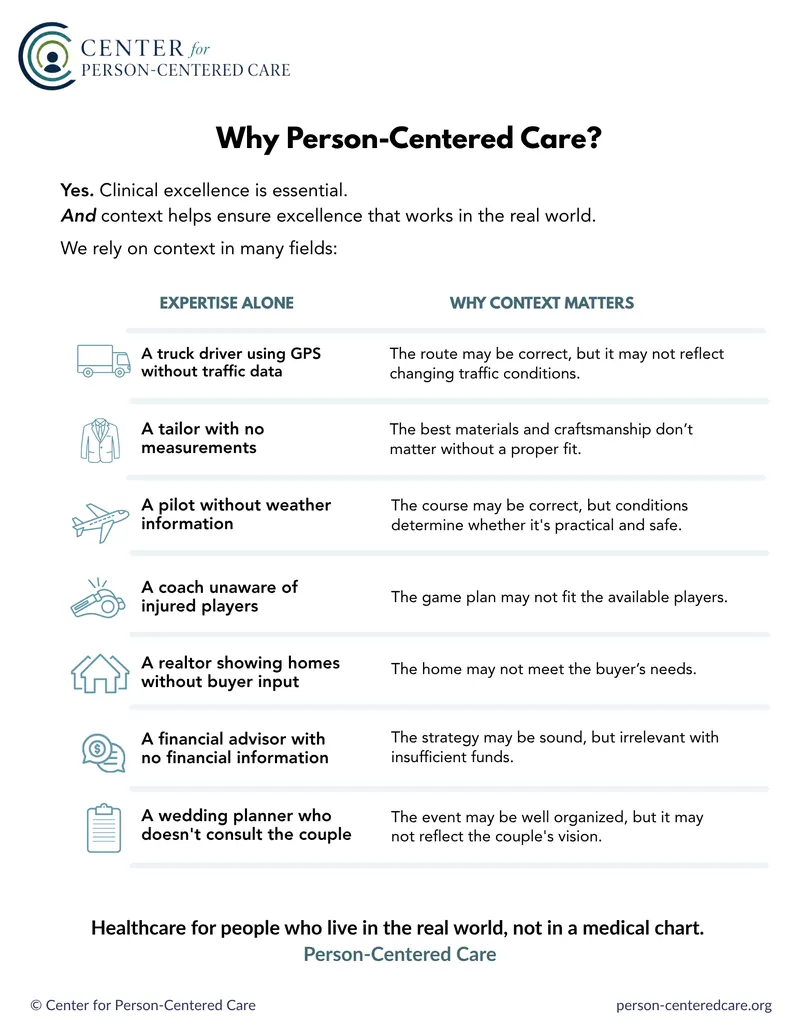
This visual illustrates why clinical expertise alone is not enough to deliver effective healthcare. Using real-world analogies from transportation, aviation, sports, finance, real estate, tailoring, and event planning, it demonstrates that context is essential for making decisions that work in the real world and contrasts “expertise alone” with “why context matters” to show that person-centered care bridges clinical excellence and everyday life.
Primary audience: Healthcare professionals, healthcare leaders, educators, students, and organizations interested in understanding why person-centered care improves healthcare decision-making.
Additional audiences: Patients and families, caregivers, researchers, patient advocates, policymakers, and anyone interested in understanding why personal context is essential to effective healthcare.
Topics Covered
- Why clinical excellence is essential but, on its own, is not enough to deliver effective healthcare.
- How context helps ensure that clinical excellence works in the real world.
- How other professions—transportation, aviation, sports, finance, real estate, tailoring, and event planning—rely on contextual information to make sound decisions.
- Why healthcare should be no different in the way it accounts for a person's circumstances.
- How person-centered care combines clinical expertise with an understanding of the person's unique circumstances.
- The contrast between “expertise alone” and “why context matters” in everyday healthcare decision-making.
Why This Resource Matters
Healthcare decisions often rely primarily on clinical expertise while overlooking the personal circumstances that determine whether a care plan is practical, achievable, and meaningful. This visual demonstrates why context is essential for translating clinical excellence into real-world outcomes.
What's Inside
- Clinical Expertise
- Context in Decision-Making
- Person-Centered Care
- Real-World Healthcare
- Healthcare Communication
- Individual Circumstances
- Practical Decision-Making
- Analogies from Transportation, Aviation, Sports, Finance, Tailoring, Real Estate, and Event Planning
Download the Resource
Formatted PDF
Includes graphics and layout.
Download PDF of Why Person-Centered Care? (PDF, opens in a new tab)Additional Resources from Other Organizations
- Institute for Healthcare Improvement (IHI) – Person- and Family-Centered Care (opens in a new tab)
Explore practical approaches for partnering with patients and families to improve healthcare quality, communication, and outcomes, including implementation examples, improvement strategies, and educational resources on person- and family-centered care.
- Agency for Healthcare Research and Quality (AHRQ) – The SHARE Approach (opens in a new tab)
Learn a practical five-step shared decision-making framework (Seek, Help, Assess, Reach, Evaluate) that helps healthcare professionals combine clinical evidence with each person’s goals, preferences, and circumstances.
- National Academy of Medicine – A Guiding Framework for Patient and Family Engaged Care (opens in a new tab)
Read the National Academy of Medicine discussion paper on advancing patient and family engaged care, including evidence, culture change, and implications for healthcare systems, training, and quality improvement.
Continue Learning
Keep exploring with another resource from the Center for Person-Centered Care.
Visual Snapshot
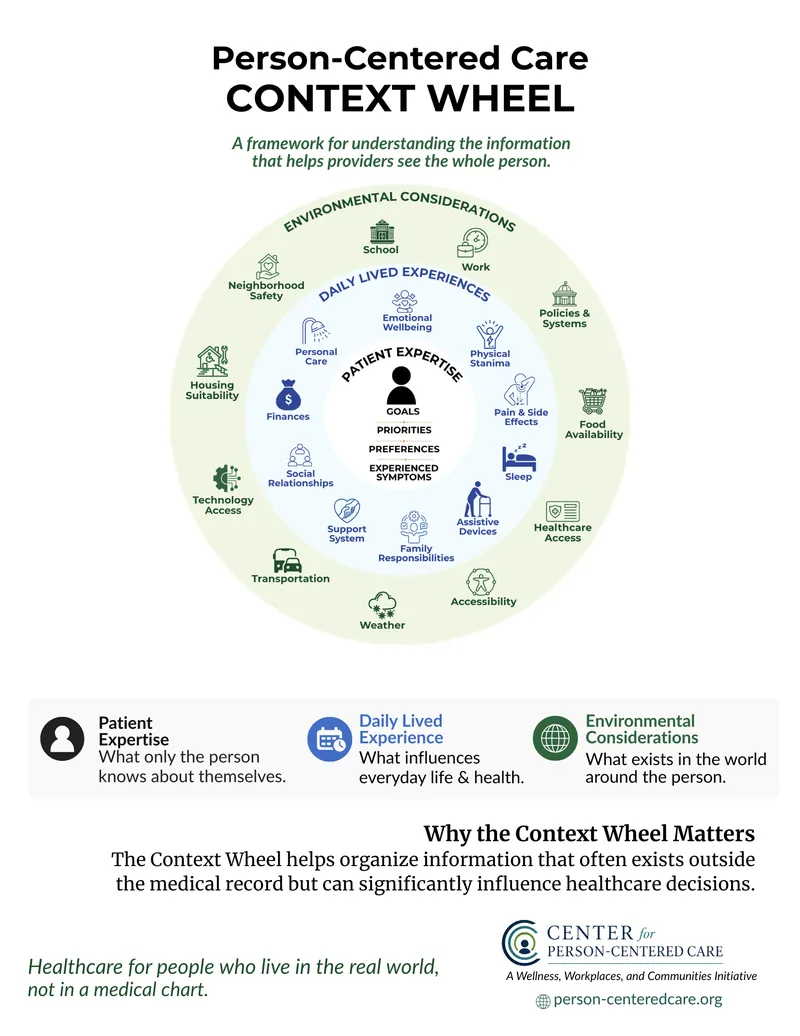
Person-Centered Care Wheel
Explore the personal and real-world factors that can help inform person-centered healthcare decisions.
Explore ResourcePair clinical expertise with the person's goals, priorities, and unique circumstances to deliver healthcare that works in the real world.
The Health Guides, Visual Snapshots, and Clinical Practice Resources were reviewed by a physician for clinical accuracy and by other reviewers to improve readability, clarity, and ease of understanding.
Back to the Resource Hub